There is a specific, high-tech hum that fills a modern kitchen when a Pressure Induction Heating (IH) rice cooker begins its work. It’s the sound of Artificial Intelligence meeting ancient grains. For anyone who has graduated from the simple “on/off” switch of a basic cooker to the sophisticated world of Zojirushi, you know that this isn’t just about boiling water; it’s about a pressurized environment designed to achieve the “Golden Ratio” of rice – sticky, plump, and sweet. Over the last month, I’ve had the unique experience of hosting both the Zojirushi NW-JEC10 and the Zojirushi NW-JEC18 on my counter.
While these two machines are identical in their “brains” and their Made-in-Japan pedigree, they operate on vastly different scales. Choosing between the 5.5-cup and the 10-cup version of the JEC series isn’t a matter of feature sets—it’s a matter of lifestyle, kitchen architecture, and thermal physics. One is the sleek, efficient choice for the modern nuclear family; the other is a heavy-duty powerhouse capable of feeding an entire neighborhood gathering. After putting both through dozens of cycles, I’ve realized that while the rice quality remains consistently elite across both, the user experience changes significantly as you scale up.
The Key Differences: Zojirushi NW-JEC10 vs NW-JEC18 Rice Cooker
Although the technology inside is mirrored, the physical and operational differences between these two models define how they fit into your daily routine:
- Volume and Output: The Zojirushi NW-JEC10 handles up to 5.5 cups of uncooked rice, which is ideal for a family of 3–5. The NW-JEC18 doubles that capacity to 10 cups (1.8 liters). If you are someone who meal-preps for the week or frequently hosts large dinner parties, the JEC18 offers a scale that the JEC10 simply cannot match.
- Countertop Presence: The Zojirushi NW-JEC18 is a substantial piece of equipment. It is nearly 1.5 inches wider and deeper than the JEC10. In a kitchen with limited prep space, the JEC10 feels like a helpful assistant, whereas the JEC18 feels like a permanent fixture.
- Steam Management and Pressure Speed: Because the NW-JEC10 has a smaller internal cookbox, it reaches its target pressure slightly faster than the JEC18. Conversely, the JEC18 handles high-volume steam more effectively, meaning that when you are cooking a full 10 cups, the moisture management is tailored to prevent any overflow or unevenness.
The Head-to-Head Comparison Table – Zojirushi NW-JEC10 vs NW-JEC18 Rice Cooker
| Feature | Zojirushi NW-JEC10 | Zojirushi NW-JEC18 |
| Capacity | 5.5 Cups (1.0 Liter) | 10 Cups (1.8 Liters) |
| Technology | Pressure IH + Artificial Intelligence | Pressure IH + Artificial Intelligence |
| Origin | Made in Japan | Made in Japan |
| Dimensions (DxWxH) | 13.62″ x 10.75″ x 8.5″ | 14.62″ x 12.00″ x 9.75″ |
| Pressure Settings | 4 Selective Textures | 4 Selective Textures |
| Exterior Finish | Clear Coated Stainless Steel | Clear Coated Stainless Steel |
| Interior | Easy-to-clean Flat Interior | Easy-to-clean Flat Interior |
| Weight | Approx. 13 lbs | Approx. 17 lbs |
| Included | Self-Standing Spatula, Measuring Cup | Self-Standing Spatula, Measuring Cup |
| View Current Price on Amazon | View on Amazon | View on Amazon |
Detailed Comparative Review: My First-Person Take
Design: The Modern Stainless Standard
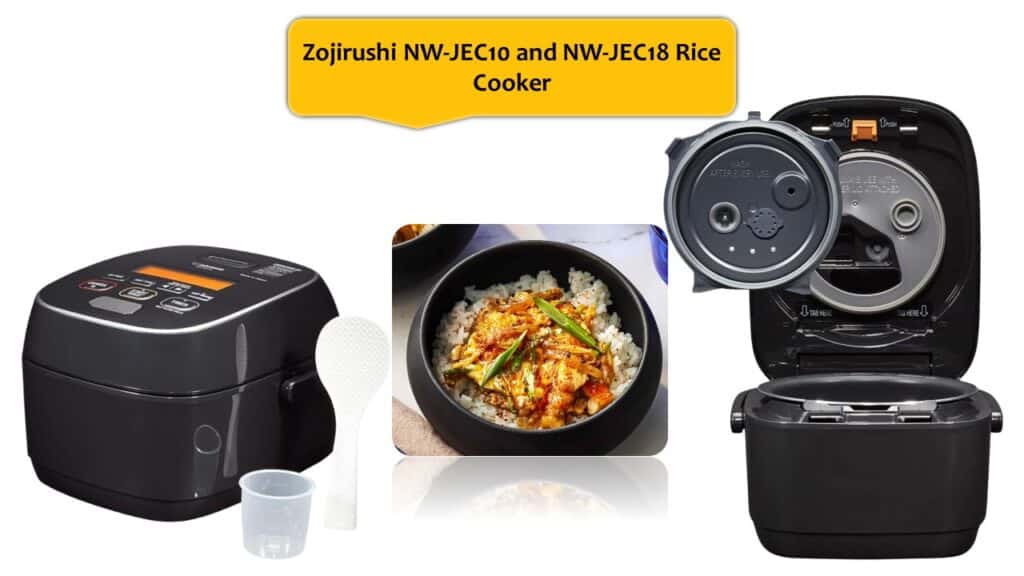
The first thing I noticed when unboxing the NW-JEC series was the transition away from the “rounded pot” look of older Zojirushi models. These units are sleek, flat-topped, and look incredibly premium. Both feature a clear-coated stainless steel exterior that is a godsend for anyone who hates fingerprints. I found that even after a messy session of prepping sushi rice with vinegar-soaked hands, the JEC10 and JEC18 both wiped clean with zero effort.
The NW-JEC10 has a very “compact-pro” feel. It’s dense and heavy for its size, signaling high-quality internals. The NW-JEC18, however, is a beast. You need to make sure your upper cabinets have enough clearance; when the lid pops open on the 10-cup model, it requires nearly 18 inches of vertical space to fully clear. If you have low-hanging cupboards, the JEC10 is the much safer bet.

- Capacity Up to 5.5 cups uncooked rice / 1.0 liter
- Pressurized Cooking and Steaming: Promotes gelatinization and produces sticky and plump rice Automatically...

- Capacity Up to 10 cups uncooked rice / 1.8 liter
- Pressurized Cooking and Steaming: Promotes gelatinization and produces sticky and plump rice Automatically...
Ease of Use: The “Learning” Cooker
This is where the AI (Artificial Intelligence) comes into play. Both of these machines “learn” from your cooking history. I noticed this most clearly with the JEC18. Because it’s a larger unit, the thermal inertia is different. On the first two batches of white rice in the JEC18, the timing was a bit off—the timer would say 5 minutes left, and then suddenly the “finish” melody would play. By the fourth batch, the AI had clearly adjusted to my water temperature and altitude.
The self-standing spatula and holder included with both are the kind of small design wins that make me loyal to Zojirushi. You never have to worry about where to put a sticky rice paddle. The control panel is intuitive, though I did find that the JEC10’s screen was slightly easier to read at eye level because the unit sits lower on the counter.
Functions: Pressure Levels and Gelatinization
The magic of the NW-JEC series is in the Pressure IH. It’s not just one pressure level; the machine automatically selects from 3 different pressure levels based on the menu.
- The Texture Test: I ran a “Firm” white rice cycle in the JEC10 and a “Soft” cycle in the JEC18. The pressure technology in both promoted perfect gelatinization. The “Firm” rice was distinct and bouncy, perfect for fried rice later that night. The “Soft” rice in the JEC18 was incredibly plump and sticky, exactly what you’d want for a morning congee or comfort bowl.
- The Steam Finish: Toward the end of the cooking cycle, I heard the distinct “click-hiss” of the pressure being applied during the steaming phase. This is designed to burn off excess moisture. In both models, this resulted in a lack of that “gummy” top layer you often get in cheaper cookers.
Maintenance: A Flat Interior is a Happy Interior
Maintenance is usually the “dealbreaker” for high-end cookers. If it’s too hard to clean, you won’t use it. Zojirushi fixed this with the JEC series. Both models have a completely flat interior. There are no ridges or deep wells where stray grains of rice can hide and rot.
The stainless steel inner lid pops off with a single click. I put the lids for both through a quick hand-wash every night. Because the JEC18 lid is larger, it’s a bit more cumbersome to rinse in a shallow sink, but the JEC10 lid is about the size of a dessert plate and a breeze to clean. One thing to note: because these use pressure, you have to be diligent about checking the steam vent for starch buildup, but both machines make this very accessible.
Zojirushi NW-JEC10 (The 5.5-Cup Daily Driver)
- Capacity Up to 5.5 cups uncooked rice / 1.0 liter
- Pressurized Cooking and Steaming: Promotes gelatinization and produces sticky and plump rice Automatically...
Pros:
- Space-Efficiency: Fits in almost any kitchen setup without sacrificing capacity for a standard family.
- Speed: Reaches pressure and temperature slightly faster for small batches.
- Aesthetic Balance: The sleek, flat top doesn’t dominate the visual space of your kitchen.
- Precision: Excellent for cooking as little as half a cup of rice perfectly.
Cons:
- Capacity Cap: Not suitable for large holiday gatherings or big families.
- Less Weight: It’s lighter, which is good for moving but feels slightly less “anchored” than the JEC18.
Zojirushi NW-JEC18 (The 10-Cup Workhorse)
- Capacity Up to 10 cups uncooked rice / 1.8 liter
- Pressurized Cooking and Steaming: Promotes gelatinization and produces sticky and plump rice Automatically...
Pros:
- Volume Leader: The ultimate tool for meal-preppers and big families.
- Thermal Stability: The larger pan holds heat exceptionally well for long-term “Keep Warm” cycles.
- Professional Feel: It feels like a piece of industrial-grade equipment.
- AI Mastery: The AI excels at adjusting for the massive thermal mass of 10 cups of rice.
Cons:
- Size: It’s a “countertop hog” and requires significant vertical clearance for the lid.
- Heavier Parts: The inner pan, when full of 10 cups of rice, is quite heavy and requires two hands for most people.
Conclusion & Recommendation: Which One Should You Buy?
The decision between the NW-JEC10 and the NW-JEC18 boils down to your average “cooking load.”
I recommend the Zojirushi NW-JEC10 if you are a household of 2 to 4 people. This is the most balanced, high-performance rice cooker on the market today. It offers the full suite of Made-in-Japan AI technology and Pressure IH benefits in a footprint that won’t make your kitchen feel crowded. It is the perfect daily companion for the average home.
I recommend the Zojirushi NW-JEC18 if you are a “Volume User.” If you have a family of 5 or more, or if you are the person who always brings the rice to the potluck, the 10-cup capacity is non-negotiable. The JEC18 handles large loads with a grace and consistency that smaller units can’t match.
Personally, the NW-JEC10 is the winner for me. Its sleek design and the way it fits under my low-clearance cabinets make it more practical for my daily life. However, if I were cooking for a full house every night, I wouldn’t hesitate to clear the space for the JEC18.
Frequently Asked Questions (FAQs)
-
Does the AI actually make the rice taste better?
Yes, but indirectly. The AI doesn’t change the flavor of the grain, but it ensures the texture is perfect by adjusting the soak and steam times based on past batches. It eliminates the “human error” of different water temperatures or ambient room heat.
-
Can I cook just one cup in the 10-cup JEC18?
You can, and the AI will adjust for it. However, the JEC10 is technically more efficient at cooking very small amounts because there is less “empty air” in the cookbox, which helps maintain the pressure more consistently for tiny portions.
-
Is “Pressure IH” worth the extra cost over standard IH?
If you like Japanese or Korean style rice (sticky, plump, and bouncy), then absolutely. Pressure IH forces moisture into the center of the grain, which a standard cooker simply can’t do. It makes even cheaper brands of rice taste premium.
-
How long do these models take to cook white rice?
On the “Regular” setting, expect about 45-55 minutes. These aren’t “fast” cookers; they are “perfect” cookers. The AI takes its time with the soaking and steaming phases to ensure the starch is properly transformed.
-
Are the inner pans dishwasher safe?
Zojirushi recommends hand-washing the inner pans. The non-stick coating is high-grade, but the harsh detergents and high heat of a dishwasher can degrade the coating and the exterior finish of the pan over time.