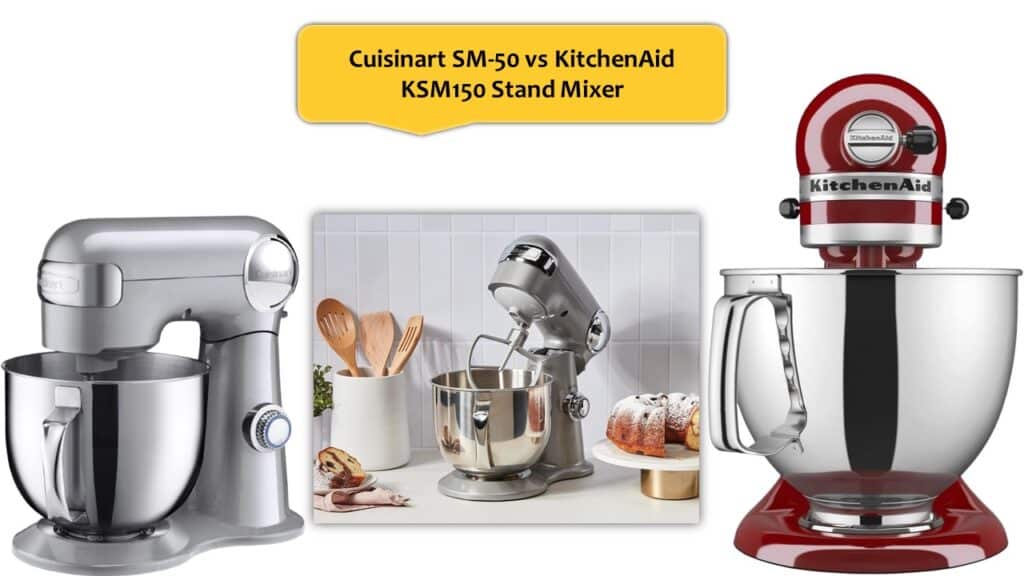
The first time I placed the Cuisinart SM-50 and KitchenAid KSM150 side by side on my countertop, I expected them to feel similar. After all, both are popular tilt-head stand mixers with similar bowl capacities and a long list of loyal users. But once I started putting them through doughs, batters, and everyday mixing tasks, the differences became surprisingly clear. Each mixer brings its own personality, strengths, and quirks, and choosing the right one depends heavily on what kind of home cook you are.
In this detailed comparison of the Cuisinart SM-50 vs KitchenAid KSM150, I’ll walk you through everything I observed after testing both mixers in real kitchen conditions. Whether you bake multiple times a week or occasionally whip up a batch of cookies, you’ll find this breakdown helpful in deciding which mixer fits your style.
Key Difference Between Cuisinart SM-50 vs KitchenAid KSM150 Stand Mixer
The key difference between the Cuisinart SM-50 and the KitchenAid KSM150 is power vs refinement. The Cuisinart SM-50 offers a significantly stronger 500-watt motor designed to handle heavy doughs more efficiently, while the KitchenAid KSM150 shines with smoother control, better build precision, and a wider ecosystem of attachments. The Cuisinart delivers raw mixing strength at a lower price; the KitchenAid offers polished performance and premium craftsmanship.


- Durable and built-to-last metal construction, with 59 touchpoints around the mixer bowl for great mixing...
- 5 Quart Stainless Steel Bowl with comfortable handle for small or large batches, to mix up 9 dozen cookies* in...
Comparison Table: Cuisinart SM-50 vs KitchenAid KSM150 Stand Mixer
| Feature | Cuisinart SM-50 | KitchenAid KSM150 |
| Motor Power | 500 watts | 325 watts |
| Bowl Size | 5.5 quarts | 5 quarts |
| Speeds | 12 | 10 |
| Build Material | Die-cast aluminum | Full metal construction |
| Weight | 18.35 lbs | 22 lbs (approx 10 kg) |
| Mixer Head | Tilt-head | Tilt-head |
| Attachments Included | Paddle, dough hook, whisk, splash guard | Paddle, dough hook, whisk, pouring shield |
| Optional Attachments | Pasta roller, extruder, grinder, ice cream maker | 15+ KitchenAid hub attachments |
| Best For | Heavy doughs, frequent baking | Versatile cooking, smooth mixing, durability |
| Check Latest Price & Deals | Buy on Amazon | Buy on Amazon |
Detailed Comparative Review
Design and Build Quality
When I unboxed the Cuisinart SM-50, its die-cast aluminum body felt solid and modern. It is lighter than the KitchenAid, which has pros and cons. On one hand, the SM-50 is easier to move around the kitchen. On the other, the lighter weight means it vibrates slightly more when kneading dense doughs.
The KitchenAid KSM150, however, immediately stands apart. The all-metal construction gives it a sturdier, more premium feel. Its impressive weight keeps it stable, even when handling dough that pushes the motor hard. The KSM150’s design also carries the signature KitchenAid aesthetic, available in more than 20 colors, which is a real advantage for people who like their appliances to match their kitchen theme.
If I had to choose based only on construction and design, the KitchenAid takes the lead for durability and elegance. But the Cuisinart still feels robust enough for regular home use.
- Durable and built-to-last metal construction, with 59 touchpoints around the mixer bowl for great mixing...
- 5 Quart Stainless Steel Bowl with comfortable handle for small or large batches, to mix up 9 dozen cookies* in...
Ease of Use
Both mixers use a tilt-head mechanism, which I personally prefer because it makes switching attachments faster. The SM-50 has a very simple control knob with 12 clearly marked speeds. I immediately noticed how easy it was to go from stirring to whipping without overthinking the settings.
The KitchenAid KSM150, while offering fewer speeds, has a smoother transition between them. The speed control on the KitchenAid feels more refined, almost like the mixer “glides” through tasks rather than abruptly shifting power. Adding ingredients is also slightly easier with the KSM150’s pouring shield, which fits more securely than Cuisinart’s splash guard.
One thing I appreciate about both models is that their attachments securely lock in place. However, the KitchenAid’s “59-point planetary mixing action” genuinely makes a difference. Ingredients incorporate more evenly, especially with sticky batters.
In day-to-day usability, the KitchenAid wins by a small margin. But if you prefer clearly defined speed levels, the SM-50 is outstanding.
Performance and Mixing Capability
This is where the battle gets interesting.
Cuisinart SM-50 Performance
The 500-watt motor is powerful. When I tested thick bread dough, the SM-50 handled it with confidence, and the motor never sounded strained. The additional bowl capacity (5.5 quarts) gives more breathing room when mixing larger batches.
For whipping cream and egg whites, the SM-50 delivers good volume and consistency. However, I noticed that at lower speeds, the mixing feels slightly less controlled than on the KSM150.
KitchenAid KSM150 Performance
Even with “only” 325 watts, the KSM150 does not feel underpowered. Its torque distribution is excellent. The planetary action makes mixing more thorough, even on slow speeds. When I tested identical dough batches, the KitchenAid kneaded more smoothly and produced a slightly better texture.
For lighter tasks like cake batter and frosting, the KSM150 performs beautifully. Its motor is quieter, and the whole process feels refined.
If you need brute power for heavy doughs, Cuisinart is the better choice.
If you prefer precision, smoothness, and consistency, KitchenAid delivers superior results.
- Durable and built-to-last metal construction, with 59 touchpoints around the mixer bowl for great mixing...
- 5 Quart Stainless Steel Bowl with comfortable handle for small or large batches, to mix up 9 dozen cookies* in...
Functions and Attachment Ecosystem
Cuisinart SM-50 Attachments
The SM-50 comes with all the essentials:
- Flat paddle
- Dough hook
- Whisk
- Splash guard
Cuisinart also offers several optional attachments like a pasta extruder, roller, and grinder. These are functional, but the ecosystem is not as extensive as KitchenAid’s.
KitchenAid KSM150 Attachments
The KSM150’s attachment hub transforms the mixer into a multi-functional cooking station. More than 15 optional attachments are available, including:
- Food grinder
- Vegetable spiralizer
- Pasta press
- Ice cream maker
- Citrus juicer
- Grain mill
The attachment quality is excellent, making the KSM150 ideal for people who want versatility beyond mixing.
For pure mixing tasks, both models are great.
For expanding your kitchen capabilities, KitchenAid is unmatched.
- Durable and built-to-last metal construction, with 59 touchpoints around the mixer bowl for great mixing...
- 5 Quart Stainless Steel Bowl with comfortable handle for small or large batches, to mix up 9 dozen cookies* in...
Cleaning and Maintenance
Both mixers include dishwasher-safe bowls and most attachments, which makes cleanup easy. The KitchenAid bowl is slightly easier to grip thanks to its comfortable handle. The Cuisinart accessories also wash well, but the splash guard is a bit more awkward to fit into the dishwasher.
Because of its metal construction, the KSM150 feels like it will last decades with proper care. The SM-50 still feels reliable but may not have the same long-term durability as KitchenAid’s legendary build.
Cuisinart SM-50 Precision Master Stand Mixer
Pros:
- Powerful 500-watt motor
- Larger 5.5-quart bowl
- Affordable price point
- 12 speeds for more control
- Lightweight and easy to move
- Includes splash guard
Cons:
- Slightly more vibration on heavy doughs
- Mixing action less refined than KitchenAid
- Attachment ecosystem is smaller
- Build quality not as premium
KitchenAid KSM150 Artisan Stand Mixer
- Durable and built-to-last metal construction, with 59 touchpoints around the mixer bowl for great mixing...
- 5 Quart Stainless Steel Bowl with comfortable handle for small or large batches, to mix up 9 dozen cookies* in...
Pros:
- Premium all-metal construction
- Extremely stable and durable
- Smooth planetary mixing action
- Excellent attachment ecosystem
- Better control at lower speeds
- Wide range of color options
Cons:
- Higher price
- Slightly smaller bowl
- Lower wattage, though still powerful
- Heavier to move around
Conclusion: My Take
After using both mixers for several weeks, the Cuisinart SM-50 vs KitchenAid KSM150 comparison comes down to your priorities as a cook.
If you want raw power, more bowl capacity, and excellent value, the Cuisinart SM-50 is a reliable workhorse that handles heavy doughs better than expected. It offers impressive performance for its price and is ideal for bakers who frequently work with large or dense mixtures.
If you want refinement, durability, and versatility, the KitchenAid KSM150 is the clear winner. Its mixing consistency, smooth controls, and access to a massive attachment ecosystem make it a long-term investment. Everything from the build to the performance feels more polished.
My Recommendation:
If your budget allows and you want a mixer that will likely outlast many appliances in your kitchen, I strongly recommend the KitchenAid KSM150. It offers a superior mixing experience, better control, and exceptional long-term value.
But if power and affordability matter more, and you often handle dense dough, the Cuisinart SM-50 delivers impressive performance without stretching your budget.
Both mixers are capable, but their strengths serve different users. Choose based on your cooking style, and you’ll be satisfied either way.