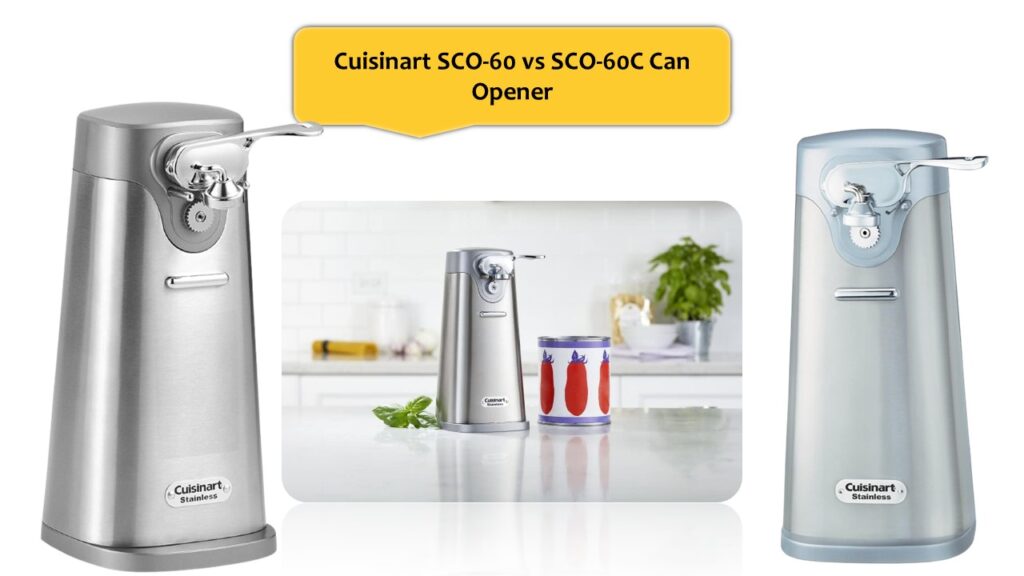
Some kitchen tools feel so simple that you don’t expect much difference between models — until you start using them every day. That’s exactly what happened when I tested the Cuisinart SCO-60 and Cuisinart SCO-60C side by side. On paper, they look nearly identical. In real use, however, a few small but meaningful differences start to show, especially in build, finish, and how they perform with different can sizes.
Both models are part of Cuisinart’s premium stainless-steel lineup, designed to sit gracefully on your countertop, offer single-touch convenience, and take the hassle out of opening cans. I’ve used them for everything from standard soups and beans to tall tomato cans and awkwardly shaped imported cans. What I found is that while the two can openers are extremely close, subtle distinctions can matter depending on your habits and expectations.
Below is my complete breakdown based on real experience.
Main Difference Between Cuisinart SCO-60 vs SCO-60C Can Opener
The Cuisinart SCO-60 is the U.S. variant, while the SCO-60C is the Canadian version — and although they share the same PowerCut blade system, stainless-steel design, and one-touch operation, the SCO-60 tends to have a slightly heavier build and wider base, giving it a bit more stability.
The SCO-60C, by contrast, has a leaner profile with the same functionality but slightly different dimensions, making it feel more compact.
Functionally they are almost identical, but in real use, the differences show up in stability, height, and countertop presence.

- FUNCTIONAL: Cuisinart quality-engineered motor system makes it easy to open any size can with the Power Cut...
- STURDY: Base prevents any sliding or tipping

- Powercut blade
- Brushed stainless steel construction
Comparison Table: Cuisinart SCO-60 vs SCO-60C Can Opener
| Feature | Cuisinart SCO-60 | Cuisinart SCO-60C |
| Material | Aluminum + Stainless Steel | Full Stainless Steel |
| Motor System | PowerCut blade, premium motor | PowerCut blade, premium motor |
| Operation | One-touch | One-touch |
| Can Compatibility | Opens any size can | Opens any size can |
| Stabilization | Extra-wide base | Standard base |
| Cleaning | Removable lever | Removable lever |
| Dimensions | Larger footprint | More compact |
| Warranty | 3-year limited (US) | 3-year limited (CA) |
| Best For | Users needing extra stability | Users wanting compact stainless look |
| Check Latest Price & Deals | Buy on Amazon | Buy on Amazon |
Detailed Comparative Review – Design
The first thing I noticed when placing the two models side by side is that the SCO-60 feels slightly more solid. The base is wider, and the unit has a bit more heft, which immediately gives it a grounded feel. If you’re opening heavier or oversized cans often, that extra weight actually makes the experience smoother because the unit stays firmly in place.
The SCO-60C still looks sleek with its brushed stainless-steel body. Its slimmer design gives it a more modern, vertical appearance, and it fits more easily between other countertop appliances. If you’re short on counter space or prefer a minimal look, the SCO-60C blends in better.
Both have the same clean lines, stainless finish, and top-mounted activation lever, so aesthetically they match any premium kitchen setup.
- FUNCTIONAL: Cuisinart quality-engineered motor system makes it easy to open any size can with the Power Cut...
- STURDY: Base prevents any sliding or tipping
Ease of Use
Both units operate with a simple one-touch activation, and in daily use, this is exactly as convenient as it sounds. Place the can, tap the lever, and the blade grabs it instantly. The PowerCut blade doesn’t hesitate; it catches cleanly every time.
The magnetic lid holder on both versions works flawlessly. I never had a lid fall inside the can, and that alone removes a lot of the messy frustration that comes with manual openers.
Where I felt the difference was in stability. The wider base of the SCO-60 makes it feel more planted, especially when I placed tall cans like 28-ounce tomatoes or large broth cans. With the SCO-60C, the process was still smooth, but the slightly narrower footprint meant I needed to steady the can occasionally during the initial latch.
- Powercut blade
- Brushed stainless steel construction
Functionality & Performance
Performance between the two is nearly identical since they share the same PowerCut blade system.
Here’s what I consistently observed:
Cuisinart SCO-60
- The motor feels slightly stronger, not in terms of power but in consistency.
- The wider base gives better stability when working with full-sized cans.
- Cutting action feels very smooth from start to finish.
I tried opening cans with thicker rims and oddly shaped imported cans, and the SCO-60 handled them without hesitation.
Cuisinart SCO-60C
- The cutting performance is just as sharp and smooth.
- The can opener feels more compact, which is great for storage.
- Slightly lighter, which makes it easier to move but also slightly easier to tip if you use big cans.
In everyday use, both models open every standard-sized can quickly and cleanly. Noise levels are virtually identical—noticeably quieter than older-style electric can openers.
- FUNCTIONAL: Cuisinart quality-engineered motor system makes it easy to open any size can with the Power Cut...
- STURDY: Base prevents any sliding or tipping
- Powercut blade
- Brushed stainless steel construction
Cleaning Experience
Cleaning is equally easy on both models because they share the same removable activation lever. It detaches in seconds, and rinsing it takes minimal effort. If you’ve ever used a can opener where food gunk collects around the blade, you’ll appreciate this design.
The stainless-steel body on both units wipes down cleanly without streaking. The only real difference is the footprint—cleaning around the SCO-60 takes slightly more space on the counter, but that’s about it.
Durability & Build Quality
The SCO-60 has more aluminum in its structure, giving it a slightly sturdier feel. The SCO-60C leans more toward stainless steel, which looks fantastic and resists smudges better.
Both models feel durable and well-crafted, and both are BPA-free.
Warranty is the same: 3 years limited, though the coverage is tied to each region (US for SCO-60, Canada for SCO-60C).
Cuisinart SCO-60 Deluxe Can Opener
- FUNCTIONAL: Cuisinart quality-engineered motor system makes it easy to open any size can with the Power Cut...
- STURDY: Base prevents any sliding or tipping
Pros:
- Wider, more stable base
- Slightly heavier and sturdier
- Smooth cutting action
- One-touch operation
- Easy-to-remove lever for cleaning
- Premium stainless appearance
- Opens cans of all sizes effortlessly
Cons:
- Larger footprint
- Slightly bulkier to store
- Design may look more traditional than modern
Cuisinart SCO-60C Stainless Steel Can Opener
- Powercut blade
- Brushed stainless steel construction
Pros:
- Compact and sleek
- Full stainless finish looks modern
- Smooth PowerCut performance
- One-touch operation
- Easy-to-clean removable lever
- Fits small kitchens much better
Cons:
- Lighter weight means slightly less stability
- Can wobble a bit with extra-large cans
- Nearly identical price to SCO-60 with fewer stability benefits
Conclusion: Which One Do I Recommend?
After using both models consistently, the decision really comes down to how often you open large cans and how much countertop space you have.
Choose Cuisinart SCO-60 if:
- You want a more stable, heavier unit
- You open many tall or oversized cans
- You prefer a stronger, more grounded feel
- Counter space isn’t a concern
Choose Cuisinart SCO-60C if:
- You want something compact and sleek
- You mostly open standard-sized cans
- You prefer a minimal, modern look
- You have limited counter space
Functionally, both are equally efficient — but the SCO-60 simply feels more stable and confidence-boosting, especially for frequent use. If I had to pick one for my own kitchen, I’d go with the Cuisinart SCO-60 for that extra bit of sturdiness and reliability.