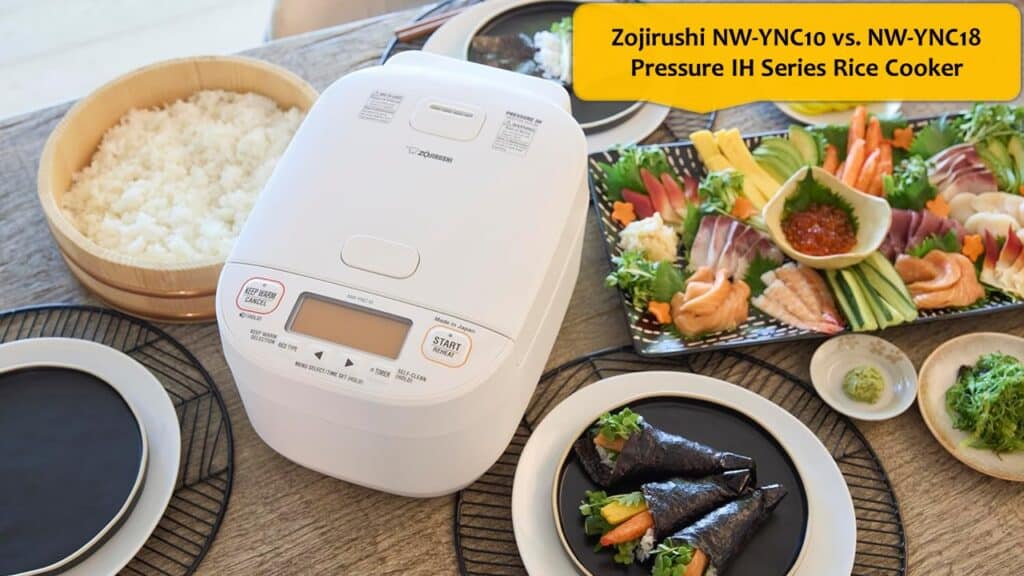
There is a specific, melodic chime that rings out in my kitchen several times a week, a sound that signals the transition from raw, hard grains to a steaming bowl of perfect rice. If you are familiar with the “Made in Japan” pedigree of Zojirushi, you know that this isn’t just an appliance; it’s a commitment to a particular kind of culinary consistency. Recently, I’ve had the pleasure of putting two siblings from the same high-end lineage through their paces: the Zojirushi NW-YNC10 and the Zojirushi NW-YNC18.
At their core, these two machines are identical twins in terms of intelligence. They both utilize the marriage of Pressure and Induction Heating (IH) to transform starch at a molecular level. However, as I began prepping for everything from a solitary breakfast of steel-cut oats to a massive family dinner featuring jasmine rice and curry, the practical reality of their size difference became the focal point.
Choosing between the 5.5-cup and the 10-cup model isn’t just about counting heads at the dinner table; it’s about understanding the thermal dynamics of a spherical inner pan and how much “countertop real estate” you are willing to sacrifice for the sake of hospitality. After a month of heavy use, I’ve broken down exactly how these two stack up when the steam starts to rise.
The Key Differences: Zojirushi NW-YNC10 vs NW-YNC18 Pressure IH Rice Cooker
While the brain of the NW-YNC series remains constant across both sizes, the physical and practical implications of the capacity shift are significant:
- Cooking Capacity and Scale: The Zojirushi NW-YNC10 is the 5.5-cup (uncooked) model, yielding roughly 11 bowls of rice. The NW-YNC18 is the 10-cup powerhouse, capable of producing up to 20 bowls. This makes the NW-YNC18 significantly larger in volume, intended for large families or those who frequently host gatherings.
- Kitchen Footprint: The Zojirushi NW-YNC18 is nearly an inch wider and over an inch taller than its smaller sibling. While that sounds minor on paper, in a compact kitchen, the 10-cup model feels substantially more imposing. The NW-YNC10 is designed for the standard household, fitting comfortably under most low-hanging cabinets.
- Thermal Performance in Small Batches: While both can cook as little as half a cup, the NW-YNC10‘s smaller spherical pan is slightly more efficient at distributing heat for tiny portions. Conversely, the NW-YNC18 excels when the pan is at least half-full, utilizing its larger surface area to maintain a consistent “flow” of pressurized steam.
The Head-to-Head Comparison Table – Zojirushi NW-YNC10 vs NW-YNC18 Pressure IH Rice Cooker
| Feature | Zojirushi NW-YNC10 | Zojirushi NW-YNC18 |
| Capacity (Uncooked) | 5.5 Cups (1.0 Liter) | 10 Cups (1.8 Liters) |
| Technology | Pressure + Induction Heating | Pressure + Induction Heating |
| Origin | Made in Japan | Made in Japan |
| Dimensions (DxWxH) | 14.5″ x 9.88″ x 8.13″ | 15.5″ x 10.75″ x 9.5″ |
| Inner Pan | 1.7mm Spherical Black Thick Pan | 1.7mm Spherical Black Thick Pan |
| Special Settings | Umami, Jasmine, Steel-Cut Oats | Umami, Jasmine, Steel-Cut Oats |
| Pressure Levels | 2 Levels (Automatic) | 2 Levels (Automatic) |
| Cleaning Feature | Self-Cleaning / Odor Reduction | Self-Cleaning / Odor Reduction |
| Exterior Color | Stylish White | Stylish White |
| View Current Price ON Amazon | View on Amazon | View on Amazon |
Detailed Comparative Review: A First-Person Perspective
Design: Clean Aesthetics and Heavy Metal
Unboxing these units, I was immediately struck by the “Stylish White” finish. Zojirushi often leans into stainless or dark finishes, so this bright, clean look felt refreshing in my kitchen. Both models share the same 1.7mm thick black spherical pan. When you pick up this pan, you can feel the weight of the stainless steel and aluminum cladding. It’s designed to be a heat reservoir.
The NW-YNC10 has a squat, efficient look to it. It’s the “Goldilocks” of rice cookers—not too big, not too small. However, the NW-YNC18 is a serious piece of machinery. The lid hinge feels slightly more heavy-duty to accommodate the larger surface area, and the orange LCD control panel is large and easy to read on both, but it feels particularly prominent on the 10-cup model.

Zojirushi NW-YNC10WA Induction Rice Cooker and Warmer 5.5 Cup, White
- Made in Japan
- Pressurized Cooking and Steaming: Promotes gelatinization and produces sticky and plump rice Automatically selects from 2 pressure levels according to the menu selected

Zojirushi NW-YNC18WA Induction Rice Cooker and Warmer10 Cup, White
- Made in Japan
- Pressurized Cooking and Steaming: Promotes gelatinization and produces sticky and plump rice Automatically selects from 2 pressure levels according to the menu selected
Ease of Use: The Orange Interface
I’ve used many rice cookers where you need a manual just to find the “start” button. These models avoid that trap. The large orange LCD is high-contrast, which was a blessing during early morning sessions when I was bleary-eyed and trying to set the timer for oatmeal.
Setting the delay timer on the NW-YNC10 was seamless. I’d set it at night, and the “Twinkle Twinkle Little Star” melody would wake me up to perfectly cooked grains. The NW-YNC18 functions exactly the same way, but I found that because the pan is deeper, I had to be a bit more careful with my water measurements. Zojirushi includes a specific measuring cup, and I learned quickly that you must use it. This isn’t a “guesstimate” machine; it’s a precision instrument.
Functions: Pressure and the Umami Factor
This series uses Pressurized Cooking, which is the secret to that “sticky and plump” texture. I did a back-to-back test with standard white rice. The pressure promotes gelatinization—essentially forcing the water into the heart of every grain.
- The Umami Setting: On both the NW-YNC10 and the NW-YNC18, the Umami setting is a revelation. It extends the soaking and steaming time. I tried this with a premium short-grain rice, and the result was noticeably sweeter.
- Quick Jasmine: Usually, “quick” settings result in hard, undercooked centers. However, the induction heating in these units is so powerful that the Quick Jasmine setting produced fluffy, fragrant rice in about half the time of a standard cycle.
- Congee and Oats: I used the NW-YNC18 to make a massive batch of congee for a weekend brunch. The larger capacity meant I could make enough for six people without the starch bubbling over the integrated steam vent.
Maintenance: Fighting the Starch
Maintenance is where Zojirushi truly separates itself from the pack. The detachable and washable inner lid is a design necessity for pressure cookers. Starch builds up in the valves, and being able to pull it off and rinse it in the sink is vital.
Both models feature a self-cleaning function. I used this after making a “Mixed Rice” dish that involved soy sauce and ginger. Usually, that scent lingers in the silicone gasket for days. I ran the self-cleaning cycle, and it significantly reduced the odor. The NW-YNC10 is slightly easier to clean simply because the parts are smaller and fit more easily in a standard drying rack.
Zojirushi NW-YNC10 (The Household Hero)
Zojirushi NW-YNC10WA Induction Rice Cooker and Warmer 5.5 Cup, White
- Made in Japan
- Pressurized Cooking and Steaming: Promotes gelatinization and produces sticky and plump rice Automatically selects from 2 pressure levels according to the menu selected
Pros:
- Perfect Proportions: Fits easily on any counter and under most cabinets.
- Small Batch Specialist: Ideal for couples or families of four.
- Rapid Heating: The smaller mass of the pan allows it to hit pressure slightly faster.
- Elegant Design: The white exterior looks modern and high-end.
Cons:
- Limited for Hosting: If you have more than 6 guests, you’ll be cooking multiple batches.
- No Room for “Bulk” Prep: Harder to meal-prep for a whole week in one go.
Zojirushi NW-YNC18 (The Hospitality King)
Zojirushi NW-YNC18WA Induction Rice Cooker and Warmer10 Cup, White
- Made in Japan
- Pressurized Cooking and Steaming: Promotes gelatinization and produces sticky and plump rice Automatically selects from 2 pressure levels according to the menu selected
Pros:
- Massive Capacity: Easily feeds a crowd or supports a week’s worth of meal prep.
- Stable Pressure: The larger pan maintains heat exceptionally well for large volumes.
- Congee Master: The depth of the pan is perfect for high-liquid dishes like congee or porridge.
- Durable Build: Everything about the 10-cup model feels reinforced.
Cons:
- Counter Hog: It requires significant space and might be too tall to open fully under some cabinets.
- Heavy Pan: When full, the inner cooking pan is quite heavy and requires two hands to carry safely.
The Final Verdict: My Recommendation
After a month of testing, the winner depends entirely on your social calendar.
I recommend the Zojirushi NW-YNC10 if you are a “Standard Household.” For the vast majority of people—singles, couples, and families with two children—the 5.5-cup capacity is the perfect sweet spot. It offers the full suite of Pressure IH technology without overwhelming your kitchen workspace. It is the most practical choice for daily use.
I recommend the Zojirushi NW-YNC18 if you are a “Volume Cook.” If you have a large family, host regular dinner parties, or like to cook 10 cups of rice on Sunday to last through Friday, the NW-YNC18 is a beast. It handles large volumes with a level of precision that smaller cookers simply can’t replicate.
In my own kitchen, the NW-YNC10 is the one that stays. Its compact size and incredible performance on small batches make it the more versatile tool for my day-to-day life. But if the holidays are coming up, I’m definitely calling in the NW-YNC18 for backup.
Frequently Asked Questions (FAQs)
-
Does the white exterior stain easily?
Surprisingly, no. The finish is quite slick, and I found that even splashes of soy sauce wiped right off with a damp cloth. However, like any white appliance, it will show dust more than a dark model, so a quick wipe once a week is a good habit.
-
Is “Pressurized” rice different from “Standard” rice?
Yes. Pressurized rice is generally stickier and “plumper.” If you prefer your rice to be very dry and separate (like a traditional pilaf), you might prefer the “Firm” setting or a non-pressure IH model. But for sushi and standard Asian-style meals, the pressure texture is superior.
-
Can I cook just one cup in the 10-cup NW-YNC18?
You can! The AI and sensors will adjust the heat. However, because the pan is so wide, a single cup of rice will sit very low in the pan. For the best results in the 10-cup model, I find that cooking at least 2 or 3 cups yields a more even texture.
-
How loud is the pressure release?
You will hear a clicking sound as the pressure valve engages and a soft hiss as it vents toward the end of the cycle. It’s significantly quieter than an old-fashioned stovetop pressure cooker and shouldn’t disturb a conversation in the next room.
-
What is the benefit of the “Spherical” pan?
The spherical shape encourages a more natural “convection” of the water and rice during the boiling phase. This keeps the grains moving and prevents them from settling into a dense, packed layer at the bottom, which results in fluffier rice.