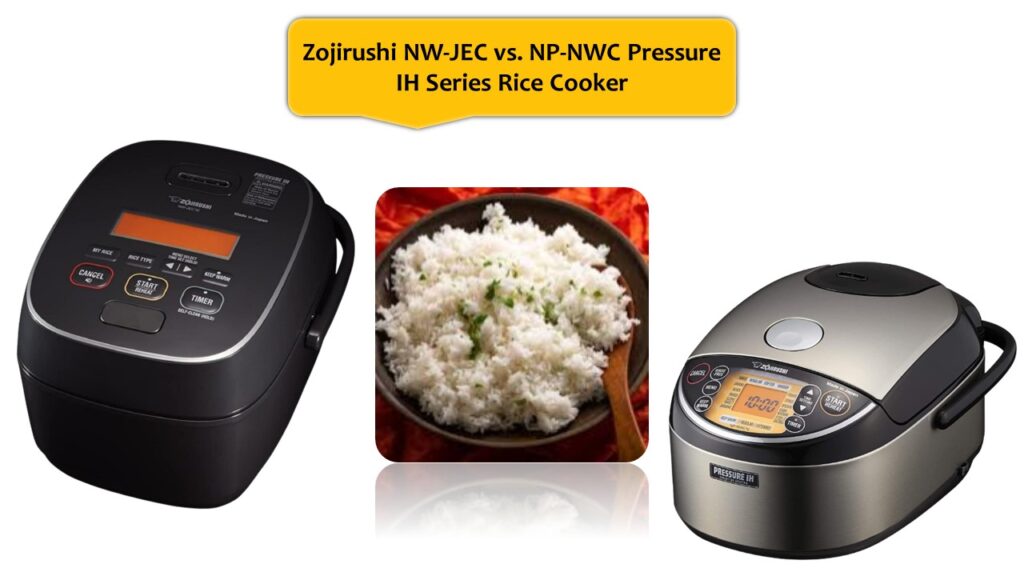
If you have ever stood in a Japanese department store staring at a wall of high-end appliances, you know that the “Made in Japan” label on a rice cooker carries a weight similar to a Swiss watch or a German car. It isn’t just about boiling water; it’s about a meticulous, computerized orchestration of pressure and induction. For the last few weeks, my kitchen has been dominated by two of the absolute titans in this field: the Zojirushi NW-JEC10/18 and the Zojirushi NP-NWC10/18.
These aren’t your standard dorm-room cookers. These are Pressure Induction Heating (IH) machines that utilize Artificial Intelligence to “learn” how you cook. They are designed for the high-volume household that demands restaurant-quality rice at the touch of a button. However, even with their shared lineage and high-tech “brains,” they offer slightly different paths to the perfect bowl.
One feels like a streamlined, futuristic evolution of the craft, while the other is a feature-packed traditionalist that leaves no menu setting behind. After pushing both through cycles of GABA brown rice, jasmine, and even steel-cut oatmeal, I’ve finally figured out which of these heavyweights truly deserves the crown on your countertop.
The Key Differences: Zojirushi NW-JEC vs. NP-NWC Pressure IH Series
While both models use the same core Pressure IH technology to gelatinize starch and produce that signature “sticky and plump” texture, the differences lie in the interface and the breadth of the menu:
- Menu Specialization: The NP-NWC is the menu king. It features a broader array of specific settings right out of the box, including dedicated cycles for Umami (an extended soak and steam for flavor) and a specific Jasmine The NW-JEC is more streamlined, focusing on the core textures but utilizing a more advanced AI to adjust the “flow” of heat.
- Physical Footprint: The NP-NWC is slightly deeper (16.5 inches) compared to the NW-JEC (14.62 inches). If you have shallow cabinets or limited counter depth, the NW-JEC offers a more compact “squat” design without sacrificing the 10-cup capacity.
- Aesthetic and Finish: The NW-JEC represents Zojirushi’s “modern” design era with a flat top and a more integrated, sleek exterior. The NP-NWC retains the classic, robust look that many Zojirushi fans have loved for years, characterized by a more pronounced lid hinge and a traditional control panel layout.
The Head-to-Head Comparison Table – Zojirushi NW-JEC vs. NP-NWC Pressure IH Series
| Feature | Zojirushi NW-JEC10/18 | Zojirushi NP-NWC10/18 |
| Technology | Pressure Induction + AI | Pressure Induction + AI |
| Pressure Levels | 3 Levels (Automatic) | 3 Levels (Automatic) |
| Pressure Settings | 4 Targeted Textures | 4 Targeted Textures |
| Capacity | 5.5 or 10 Cups | 5.5 or 10 Cups |
| Special Settings | Regular, Soft, Hard | Umami, Jasmine, Congee, GABA |
| Inner Lid | Stainless Steel (Detachable) | Stainless Steel (Detachable) |
| BPA-Free | Yes | Yes (Food Contact Areas) |
| Origin | Made in Japan | Made in Japan |
| Included Accessories | Spatula, Stand, 1 Cup | Spatula, Holder, 2 Cups (Reg/Green) |
| View Current Price on Amazon | View on Amazon |
Detailed Comparative Review: A First-Person Perspective
Design: The Battle of Modernity and Tradition
When I first unboxed the NW-JEC, I was struck by how much cleaner it looked on my counter. It has a flat top that makes it feel less like a “pot” and more like a high-end kitchen computer. The exterior is clear-coated stainless steel, which I found to be remarkably resistant to the steam-induced water spots that usually plague these machines.
The NP-NWC, by comparison, feels like a tank. It’s slightly heavier and deeper, taking up more real estate. However, there is something incredibly reassuring about the build quality of the NP-NWC. It feels permanent. While the NW-JEC looks better in a minimalist, modern kitchen, the NP-NWC looks like it’s ready to survive twenty years of daily use without breaking a sweat.

- Capacity Up to 5.5 cups uncooked rice / 1.0 liter
- Pressurized Cooking and Steaming: Promotes gelatinization and produces sticky and plump rice Automatically...
Ease of Use: AI in the Kitchen
Both of these machines utilize Artificial Intelligence, and you can actually “feel” it working. On my first few batches of rice in the NW-JEC, the timing was a bit variable. By the fifth batch, the machine had “learned” my local temperature and water hardness, and the countdown timer became eerily accurate.
The NP-NWC is just as smart, but I found the interface slightly more intuitive if you like having a specific button for every task. The inclusion of two measuring cups with the NP-NWC – a standard one and a green one for rinse-free rice – is a small touch, but it shows the level of detail Zojirushi puts into the user experience. You don’t have to guess; the machine tells you exactly what to do.
Functions: The Texture Wars
This is where the Pressure IH technology earns its high price tag. I tested “Regular White Rice” in both. Both models use pressure at the very end of the cycle to “burn off” excess moisture. The result in both was spectacular – each grain was individually plump, not mashed together.
However, the NP-NWC pulled ahead when I tested Jasmine rice. Most Zojirushi models struggle with long-grain rice, but the dedicated Jasmine setting on the NP-NWC adjusted the pressure and temperature perfectly to keep the grains long and fragrant rather than making them too sticky. The NW-JEC did a fine job on the “Regular” setting, but it required a bit more tweaking of the water line to get that perfect fluffy separation. If you are a fan of the Umami setting, the NP-NWC is the clear winner. It extends the soaking time at a specific temperature to draw out the natural sugars of the rice, resulting in a noticeably sweeter, richer flavor.
Maintenance: Keep It Clean
Cleanup is surprisingly easy for such complex machines. Both have detachable stainless steel inner lids. I cannot stress enough how important this is – starch builds up in the steam vent, and being able to pop that lid off and rinse it in the sink is mandatory.
The NW-JEC has a slight edge here because the interior is very flat. There are fewer nooks and crannies for a stray grain of rice to hide. I was able to wipe down the interior with a damp cloth in about ten seconds. The NP-NWC is also easy to clean, but its deeper frame and more traditional hinge design mean you have to be a bit more diligent about checking the edges for stray steam residue.
Zojirushi NW-JEC10/18 (The Sleek Evolution)
- Capacity Up to 5.5 cups uncooked rice / 1.0 liter
- Pressurized Cooking and Steaming: Promotes gelatinization and produces sticky and plump rice Automatically...
Pros:
- Space-Saving Design: Shorter depth makes it much easier to store and use on standard counters.
- Modern Aesthetic: The flat-top design and clear-coated finish are stunning.
- Intelligent Flow: The AI feels very responsive to subtle changes in rice variety.
- Self-Standing Spatula: A small but brilliant addition that keeps your counter clean.
Cons:
- Limited Specialty Menus: Lacks the dedicated Umami and Jasmine buttons found on the NP-NWC.
- Simplified Interface: Might feel “too simple” for power users who want granular control over every grain type.
Zojirushi NP-NWC10/18 (The Feature-Packed Traditionalist)
Pros:
- Menu Variety: Dedicated settings for Jasmine, Congee, and Umami are a game-changer.
- GABA Brown Specialist: Produces incredibly soft, nutritional brown rice.
- Robust Construction: Feels like the “Gold Standard” of Zojirushi build quality.
- Precision Accessories: Includes everything you need for both regular and rinse-free rice.
Cons:
- Large Footprint: Requires a lot of counter depth; may not fit in all cabinets.
- Traditional Design: Might look a bit dated compared to the newer “flat-top” models.
The Final Verdict: My Recommendation
After weeks of eating more rice than I probably should, I’ve reached a clear conclusion.
I recommend the Zojirushi NW-JEC10/18 if you prioritize design and space. If you have a modern kitchen and want a machine that looks as good as the food it produces, the NW-JEC is a masterpiece. It offers the full power of Pressure IH technology in a more compact, aesthetically pleasing package. It’s perfect for the family that mostly eats high-quality white and brown rice and wants a “smart” machine that handles the details automatically.
I recommend the Zojirushi NP-NWC10/18 if you are a Grain Enthusiast. If your pantry is filled with Jasmine, Basmati, Brown, and Rinse-free rice, the NP-NWC is worth every penny. The dedicated Umami and Jasmine settings provide a level of specialization that the NW-JEC can’t quite match. It is the ultimate tool for someone who wants the widest possible variety of textures and flavors.
Personally, the NP-NWC is the one that stays on my counter. While it’s a bit bulkier, the “Umami” setting has spoiled me – I simply can’t go back to standard rice now that I know how much flavor these grains can actually hold.
Frequently Asked Questions (FAQs)
-
Does the AI actually make a difference?
Yes! The AI monitors the temperature of the internal pan and the external environment. If you are cooking on a cold winter day versus a humid summer afternoon, the AI adjusts the soaking and heating times to ensure the rice is identical every time. You’ll notice the timer adjusting itself during the first 10 minutes of the cycle.
-
Can I make small amounts in a 10-cup cooker?
You can, but these machines perform best when you cook at least 2 or 3 cups. If you consistently only cook 1 cup of rice, I highly recommend looking at the 5.5-cup versions of these same models (NW-JEC10 or NP-NWC10).
-
What is the “Umami” setting exactly?
It’s a specialized cycle that extends the soaking time at the beginning of the cook. This triggers an enzymatic reaction in the rice that releases more sugar and amino acids, resulting in a deeper flavor. It also includes an extended steaming phase at the end.
-
Are these rice cookers loud?
Because they use pressure, you will hear a distinct “click” as the pressure regulator engages, and a “whoosh” of steam at the very end. However, they are generally very quiet during the actual cooking phase. The melodies they play at the start and finish are adjustable or can be turned off.
-
Is the “Pressure” feature safe?
Absolutely. These are not like the stovetop pressure cookers of old. They have multiple redundant safety valves and the computer monitors the pressure levels in real-time. You cannot open the lid while the unit is under pressure, and it automatically vents before the “ready” signal sounds.