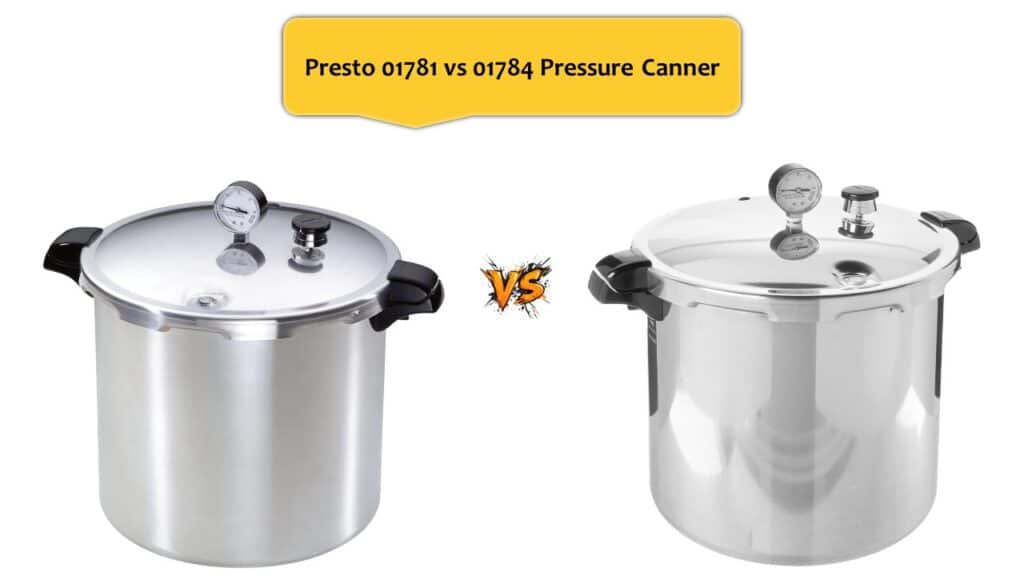
I’ve spent plenty of time canning over the years, and two models I’ve come back to repeatedly are the Presto 01781 and the Presto 01784. On paper, these two look almost identical — both are 23-quart classics, both come from the same brand, and both follow the traditional manual pressure canning style that home canners trust.
But once you actually start working with them, some distinct differences show up — mainly in stovetop compatibility, design feel, and how each one performs depending on your setup. After using both models in my kitchen over several canning sessions, I’ve formed a clear opinion of where each one shines.
Here’s my full breakdown.
Main Difference Between Presto 01781 vs 01784 Pressure Canner
The primary difference between the Presto 01781 and 01784 is simple:
The Presto 01784 has an induction-compatible stainless steel base, while the Presto 01781 does not.
Both are durable aluminum canners, but the 01784 is designed to work on all stovetop types, including induction, whereas the 01781 is limited to gas, electric coil, and smooth-top electric ranges.
If you have (or plan to upgrade to) an induction range, the 01784 is your only option.
If not, both canners will perform almost identically.

Presto 01781 23-Quart Pressure Canner and Cooker
- The only method recommended safe by the US Department of Agriculture for canning vegetables, meats, poultry, and seafood
- Doubles as a boiling-water canner for preserving fruits, jams, jellies, pickles, and salsa; Handy as a large capacity pressure cooker

Presto 01784 23-Quart Induction Compatible Pressure Canner | Canning Supplies, Pressure Canners, Induction Compatible Canners, Home Canning, meats and fish,…
- INDUCTION-COMPATIBLE: Full-sized consumer pressure canner designed to work on induction ranges, gas, electric, and smooth-top stoves. Versatile and reliable for all your canning needs
- SAFE & USDA-APPROVED: Achieve safe and confident canning with the only method recommended by the USDA for preserving vegetables, meats, poultry, and seafood. Includes precise pressure gauge for accuracy
Comparison Table: Presto 01781 vs 01784 Pressure Canner
| Feature | Presto 01781 | Presto 01784 |
| Capacity | 21.8 L (23 qt) | 23 L (23 qt) |
| Material | Aluminum | Aluminum with stainless steel-clad induction base |
| Stovetop Compatibility | Gas, electric coil, smooth-top electric | Gas, electric, smooth-top, induction |
| Dimensions | 15.5″ D × 17.5″ W × 13.5″ H | 13.5″ D × 17.5″ W × 15.5″ H |
| Weight | 12 lbs | Heavier due to stainless clad base |
| Special Feature | Manual | Induction-compatible, manual |
| Safety System | Air vent/cover lock + pressure dial gauge | Same system |
| Capacity in Jars | 7 quarts, 20 pints, 26 half-pints | 7 quarts, 20 pints, 26 half-pints |
| Dishwasher Safe | No | Yes (according to listing) |
| Best For | Traditional stovetops | All stovetops, including induction |
| Check Latest Price & Deals | Buy on Amazon | Buy on Amazon |
Detailed Comparative Review
-
Design and Build Quality
I’ll start with something that surprised me: although both are labeled as 23-quart canners, their build and feel aren’t identical when you set them side by side.
Presto 01781
The 01781 is the lighter of the two. It’s made from heavy-gauge aluminum, and even though it’s large, it doesn’t feel overwhelmingly heavy when lifting it onto the stove. It also heats fast because aluminum distributes heat quickly across the bottom.
The finish is pretty much what you expect from a Presto canner — functional, clean, slightly old-school.
Presto 01784
The 01784 looks almost the same at first glance, but the moment you lift it, the difference hits you.
It has a stainless steel-clad base, which gives it a more solid feel and a bit more weight.
This change is essential for induction cooking, but it also benefits heat distribution even on gas and electric ranges. I noticed slightly more uniform heating on my smooth-top stove with this model.
If durability matters to you, the 01784 has a small edge simply because of that reinforced base.
Presto 01781 23-Quart Pressure Canner and Cooker
- The only method recommended safe by the US Department of Agriculture for canning vegetables, meats, poultry, and seafood
- Doubles as a boiling-water canner for preserving fruits, jams, jellies, pickles, and salsa; Handy as a large capacity pressure cooker
Presto 01784 23-Quart Induction Compatible Pressure Canner | Canning Supplies, Pressure Canners, Induction Compatible Canners, Home Canning, meats and fish,…
- INDUCTION-COMPATIBLE: Full-sized consumer pressure canner designed to work on induction ranges, gas, electric, and smooth-top stoves. Versatile and reliable for all your canning needs
- SAFE & USDA-APPROVED: Achieve safe and confident canning with the only method recommended by the USDA for preserving vegetables, meats, poultry, and seafood. Includes precise pressure gauge for accuracy
-
Ease of Use
Both units are manual pressure canners with a dial gauge, so the learning curve is the same for each one.
Here’s what stood out to me while using them:
Lid System
The lid, the air vent, and the cover lock function exactly the same. Both models seal tightly and only allow pressure to build once everything is locked properly. That classic Presto locking system hasn’t failed me yet.
Using Them on the Stove
- On my gas stove, both worked exactly the same.
- On my smooth-top electric, the 01784 gave me a slightly steadier boil and more stable pressure because the stainless base distributes heat more evenly.
And, of course, the 01781 cannot be used on induction, so if you only have induction, that’s an immediate deal-breaker.
Weight and Handling
The 01781 is easier to lift and pour because it’s noticeably lighter. If you struggle with heavy cookware, you’ll prefer this one. But to be honest, once either canner is filled with jars and water, both become heavy anyway.
Presto 01781 23-Quart Pressure Canner and Cooker
- The only method recommended safe by the US Department of Agriculture for canning vegetables, meats, poultry, and seafood
- Doubles as a boiling-water canner for preserving fruits, jams, jellies, pickles, and salsa; Handy as a large capacity pressure cooker
-
Functions and Performance
Both canners serve:
✔ Pressure canning for low-acid foods (USDA-approved)
✔ Water-bath canning for jams, pickles, and fruits
✔ Large-capacity pressure cooking
In terms of pure canning performance, here’s what I experienced:
Heat-Up Time
The 01781 heats up faster because it’s aluminum-only.
The 01784 takes a little longer because of the stainless base — but the difference isn’t huge.
Temperature / Pressure Stability
The 01784 had slightly more consistent steady pressure on electric stoves, probably because stainless holds heat better than aluminum.
On gas, they’re identical.
Jar Capacity
Both canners fit:
- 7 quart jars
- 20 pint jars (stacked)
- 26 half-pints
No difference here.
Dial Gauge Accuracy
The dial gauges on both were similar. I tested both using a local extension office’s equipment, and accuracy was almost identical.
Presto 01781 23-Quart Pressure Canner and Cooker
- The only method recommended safe by the US Department of Agriculture for canning vegetables, meats, poultry, and seafood
- Doubles as a boiling-water canner for preserving fruits, jams, jellies, pickles, and salsa; Handy as a large capacity pressure cooker
Presto 01784 23-Quart Induction Compatible Pressure Canner | Canning Supplies, Pressure Canners, Induction Compatible Canners, Home Canning, meats and fish,…
- INDUCTION-COMPATIBLE: Full-sized consumer pressure canner designed to work on induction ranges, gas, electric, and smooth-top stoves. Versatile and reliable for all your canning needs
- SAFE & USDA-APPROVED: Achieve safe and confident canning with the only method recommended by the USDA for preserving vegetables, meats, poultry, and seafood. Includes precise pressure gauge for accuracy
-
Safety Features
Both units share the same safety system:
- Cover lock prevents opening under pressure
- Air vent/steam release regulates internal pressure
- Durable gasket sealing ring
- Dial gauge for monitored accuracy
These are reliable, old-school canners, and the safety design is the part Presto has perfected over decades. I felt equally confident using both.
-
Cleaning and Maintenance
Because of the stainless-clad bottom, the 01784 is technically dishwasher safe, whereas the 01781 is not.
But realistically, neither one fits comfortably in a dishwasher anyway.
What actually mattered to me was the following:
- The aluminum body of both canners cleans easily.
- The 01784’s base resists discoloration better over time.
- The 01781 tends to get more “stove ring marks,” especially on electric coils.
Presto 01781 Pressure Canner
Presto 01781 23-Quart Pressure Canner and Cooker
- The only method recommended safe by the US Department of Agriculture for canning vegetables, meats, poultry, and seafood
- Doubles as a boiling-water canner for preserving fruits, jams, jellies, pickles, and salsa; Handy as a large capacity pressure cooker
Pros:
- Lightweight and easier to move
- Heats quickly due to full aluminum body
- Classic, proven design
- Works on most stoves (except induction)
- More affordable
- Great for beginners who want a large manual canner
Cons:
- Not induction compatible
- Base may discolor over time
- Slightly less heat distribution accuracy on smooth-top stoves
Presto 01784 Pressure Canner
Presto 01784 23-Quart Induction Compatible Pressure Canner | Canning Supplies, Pressure Canners, Induction Compatible Canners, Home Canning, meats and fish,…
- INDUCTION-COMPATIBLE: Full-sized consumer pressure canner designed to work on induction ranges, gas, electric, and smooth-top stoves. Versatile and reliable for all your canning needs
- SAFE & USDA-APPROVED: Achieve safe and confident canning with the only method recommended by the USDA for preserving vegetables, meats, poultry, and seafood. Includes precise pressure gauge for accuracy
Pros:
- Fully induction compatible
- Stainless steel-clad bottom offers more even heating
- Slightly more durable design
- Safer stability on smooth-top electric ranges
- Works on every type of cooktop
- Dishwasher safe (per manufacturer)
Cons:
- Heavier than the 01781
- Takes slightly longer to heat up
- Usually more expensive
Conclusion: Which One Should You Buy?
After using both the Presto 01781 and 01784 extensively, I’d sum them up like this:
- If you do not have an induction stove and want a classic, reliable, affordable pressure canner that heats quickly, the Presto 01781 is an excellent choice. It has been a go-to model for home canners for years and performs exactly as expected.
- If you want the most versatile, future-proof, and stovetop-compatible model — or if you’re moving toward induction cooking — then the Presto 01784 is absolutely worth the upgrade. The stainless-clad base alone adds more stability and long-term durability.
My personal recommendation:
If you can stretch your budget, go with the Presto 01784.
It works on every stove, heats more evenly, and feels like the more polished version of the two.
But if you want the most economical option without giving up any canning capacity, the 01781 still delivers excellent long-term performance.